Quantum Tunneling Composite (QTC): How Pressure Sensors Work
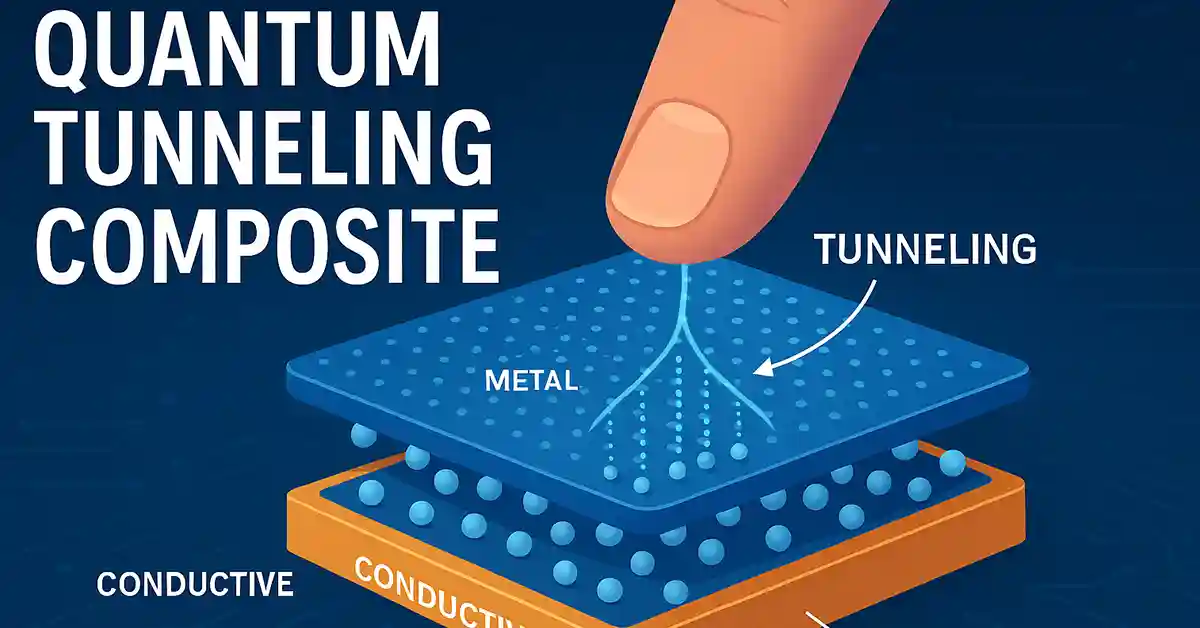
What is a quantum tunnelling composite (QTC)? It is a pressure-sensitive material made from an insulating, flexible polymer containing conductive particles, often nickel. Unpressed, the particles remain electrically separated; when the material is squeezed, tiny gaps narrow and electrons can tunnel between particles, causing a large drop in electrical resistance. QTC material is therefore useful for force-sensitive touch controls and experimental tactile sensors. The mechanism has been investigated in peer-reviewed pressure-sensor research. “Quantum tunneling composite” is the US spelling; “quantum tunnelling composite” is also common.
A flexible sheet can behave very differently when you press it: electrical resistance that is high at rest can drop sharply under compression. That is the useful trick behind quantum tunnelling composite (QTC), a polymer containing conductive particles whose spacing changes when the material deforms. The response makes QTC useful for detecting the force of a touch, not just whether a button was pressed.
How Quantum Tunnelling Composite (QTC) Material Works
Inside classic nickel-filled QTC, tiny conductive particles are held apart by an insulating polymer. Compression reduces the gaps and can sharply increase the probability of electrons tunnelling between particles, even without direct metal-to-metal contact. Because tunneling probability rises exponentially with shorter distances, a tiny deformation triggers a colossal drop in resistance—useful for pressure-sensitive sensors. (peer-reviewed characterization study)
Where Quantum Tunnelling Composite Came From
QTC emerged from conductive-adhesive experimentation in the late 1990s. Its inventor, David Lussey, went on to help develop the material commercially through Peratech. Subsequent laboratory research described how deformation influences electron tunnelling and sensor response, laying the groundwork for practical pressure-sensitive devices. (research history and mechanism)
The Silent Guardian
A vow of silence. A mission across centuries. One assassin holds the fate of humanity in his hands.
Adam never chose to be silent; the Phylax demanded it. Trained from childhood as a time-traveling enforcer, he slips through centuries to eliminate those who threaten the future. His latest mission: assassinate Emperor Qin Shi Huang before a ruthless plot ultimately destroys humankind.
What Research Shows About QTC Sensors
Quantum tunnelling composites are not merely a proposed future material: researchers have tested their electrical response, compared commercial sensors, and investigated specialized designs. A 2010 characterization and modelling study describes how deformation brings conductive particles close enough for electron tunnelling to change resistance. The size and shape of the particles, polymer matrix, electrodes and amount of force all influence the result.
- Comparing force sensors: A 2024 study in Sensors investigated 48 Peratech QTC SP200 sensors and 48 Interlink FSR402 sensors, comparing force-response performance and exploring predictive models. The paper reports overlapping operating force ranges for these specific models; neither product represents every sensor of its type.
- Industrial seal monitoring: A 2023 study tested carbon-nanostructure-filled elastomer seals whose electrical resistance responds to compression. This is a research application of QTC-like sensing rather than proof that every future industrial seal will contain QTC.
- Trackpad development: Peratech describes its Hydra multi-force trackpad technology as combining localized force sensing and configurable haptic feedback. These are manufacturer-stated product capabilities, not a claim that the technology is present in every laptop.
Hands-on next step: Our QTC sensor and Arduino voltage-divider tutorial explains a low-voltage analog readout and why sensor-specific calibration matters.
Is Quantum Tunnelling Composite the Same as an FSR?
Not quite. A force-sensing resistor (FSR) is a type of sensor whose electrical resistance varies with applied force. Quantum tunnelling composite (QTC) describes a pressure-sensitive material and a conduction mechanism that can be used inside an FSR. Conventional FSR designs may depend on different combinations of particle contact, percolation and tunnelling. The terms therefore overlap rather than describe two completely separate device categories.
Performance depends on the whole sensor assembly. Compare actual specifications for usable force range, repeatability, hysteresis, drift, sensing area and operating voltage instead of assuming that one material is universally better. For a component-by-component explanation, read QTC vs. force-sensing resistors: how the sensors differ.
How to Read a QTC Resistance-vs-Force Graph
In a typical compression test, more applied force produces lower measured resistance, although the curve is not necessarily a straight line. A graph might use a logarithmic resistance axis to display changes spanning several orders of magnitude. Start by checking the axes and units, the loading direction, the test voltage, and whether the result comes from a single sample or several sensors.
Two practical cautions matter: hysteresis means the output during unloading can differ from loading at the same force, while drift means the signal can change over time even when the applied force is held steady. A sensor also needs calibration in the mechanical setup in which it will actually be used. Our illustrated guide to reading QTC force-resistance graphs explains these effects step by step.
QTC Pills, Sheets, and Other Sensor Formats
The form factor determines how a QTC element fits into a device. A small pill or button-shaped element can suit a localized force input. A sheet can cover a wider contact area or be integrated with patterned electrodes for spatial sensing. Neither format has a universal response curve: thickness, electrode geometry, mounting, contact area and material formulation change what the electronics measure.
Before choosing one, consider whether you need a single squeeze point, a distributed tactile surface, or a flexible prototype. See QTC pills vs. sheets: which format fits? for a practical design comparison.
Where Quantum Tunnelling Composite Is Useful
- Force-sensitive touch interfaces: Buttons, input surfaces and trackpad prototypes can use a change in resistance to estimate the strength of a press.
- Robotics and tactile research: Electrode arrays and flexible composites can help researchers map contact pressure across a surface; see the review of flexible tactile sensors.
- Wearable and pressure-monitoring experiments: Researchers have evaluated QTC-based sensors for force measurements on curved and compliant surfaces, where calibration and the surrounding material matter.
- Self-sensing industrial parts: Experimental compression-sensitive seals show how a component might monitor its own mechanical condition instead of relying solely on a separate sensor.
Limitations: Why a QTC Sensor Still Needs Calibration
QTC is responsive, but high sensitivity does not mean perfect accuracy. Its output can be affected by viscoelastic relaxation of the polymer, mechanical history, temperature, contact geometry, specimen variation and the measurement circuit. In a 2017 materials study, researchers linked electrical resistance relaxation partly to stress relaxation in the composite.
The Peratech SP200 datasheet reports a typical 0.1–20 N operating-force range and 8.5% hysteresis for that particular series. Treat such numbers as device-specific specifications, not inherent constants of QTC materials. Check the manufacturer’s limits and measure a calibration curve under your intended loading conditions.
Common Questions About QTC
Does QTC conduct electricity without metal particles touching?
In the classic nickel-filled QTC explanation, yes: compression reduces the gaps between irregular metal particles, making quantum tunnelling an important conduction mechanism. The exact behavior of other particle-filled composites can involve multiple mechanisms.
Does resistance always decrease when you press harder?
It often does across a sensor’s designed operating range, but not necessarily at every force, shape or loading history. Read the tested resistance-force curve rather than extrapolating indefinitely.
Is a QTC sensor ready to measure precise weight or pressure?
Not on its own. Resistance is an electrical measurement, while force and pressure must be inferred using a particular calibration, contact area and mechanical design. For quantitative measurements, validate the assembled sensor against known loads.
Key Takeaway
Quantum tunnelling composite makes mechanical force electrically measurable by dramatically changing its resistance when deformed. The material is promising for tactile interfaces and specialized sensing, but reliable applications depend on the complete sensor design and calibration. Start with the physics, then compare real devices, their force-response curves and their form factors before selecting a QTC solution.
Read Next: Quantum Tunnelling Composite Guides
- QTC vs. force-sensing resistors: differences and trade-offs
- How to read a QTC force-versus-resistance graph
- QTC pills vs. sheets: choosing a sensor format
New to the physics? Start with 31 quantum physics terms explained.