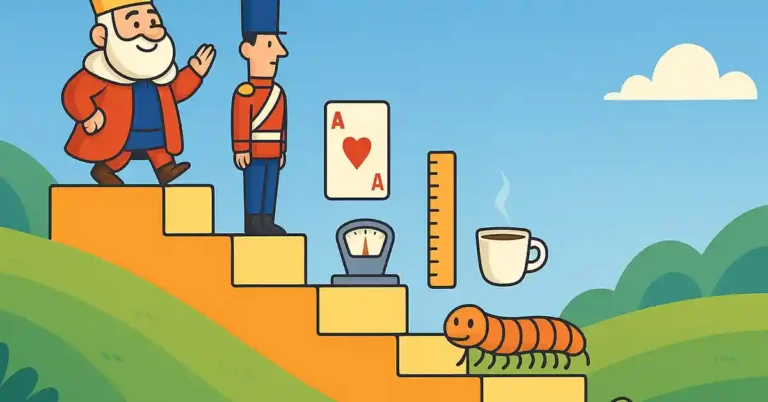
King Henry Metric Conversion Practice: 20 Questions & Answers
Need King Henry metric conversion practice with answers? This free, printable worksheet gives you 20 original problems using the metric-prefix ladder. It covers metres, litres and grams, then adds trickier prefixes and everyday word problems. An answer key explains the number of steps and the direction of the conversion.
King Henry’s Metric Prefix Ladder: Quick Reminder
Remember “King Henry Died By Drinking Chocolate Milk”: Kilo → Hecto → Deka → Base unit → Deci → Centi → Milli. The base unit in this shortcut is a metre (m), litre (L), or gram (g), depending on what you are measuring. The ladder is a memory aid for these familiar prefixes, not the entire SI system.
Moving right: the destination unit is smaller, so the number gets larger: multiply by 10 each step. Moving left: the destination unit is larger, so the number gets smaller: divide by 10 each step. Double-check that your starting and ending units measure the same kind of quantity: length with length, mass with mass, or volume with volume.
Worked example: 0.72 km → m. Count kilo → hecto → deka → metres: 3 steps right. Multiply 0.72 by 1,000 to get 720 m. In the opposite direction, 3,500 mL → L is three steps left, giving 3.5 L.
For an explanation of why the prefix names work, a conversion chart and alternative mnemonics, read our metric system mnemonic and King Henry conversion-ladder guide.
How to Print This Practice Worksheet
Use your browser’s Print command (Ctrl+P on Windows or Command+P on Mac). Print the questions for a learner and keep the answer-key section below for checking. You can choose a page range in the print dialog if you want to exclude the answer key. No account or worksheet download is required.
Metric Conversion Worksheet: 20 Practice Questions
Instructions: Write the converted value with its unit. For problems 1–16, use the King Henry ladder to count the steps. For 17–20, decide which operation you need before converting. Try without a calculator, then check the key.
Part A: Everyday metric conversions (1–10)
- 3.2 km → m: __________________
- 0.45 m → cm: __________________
- 780 mm → cm: __________________
- 2.6 L → mL: __________________
- 950 mL → L: __________________
- 4.7 kg → g: __________________
- 2,300 g → kg: __________________
- 67 cm → m: __________________
- 0.08 m → mm: __________________
- 5,600 mg → g: __________________
Part B: Hecto, deka, deci and centi (11–16)
- 3.5 dL → mL: __________________
- 0.42 daL → L: __________________
- 7.5 hm → m: __________________
- 0.06 km → cm: __________________
- 250 cL → L: __________________
- 1.4 dg → mg: __________________
Part C: Word problems (17–20)
- Two bottles, each 750 mL: find total litres. __________________
- Three parcels, each 0.35 kg: find total grams. __________________
- A ribbon measures 6 cm: find millimetres. __________________
- A 2 L jug already contains 1,250 mL: find empty capacity in mL. __________________
Challenge: For questions 11, 14 and 16, also write the number of steps and the direction. Why does question 20 need subtraction as well as metric conversion?
Answer Key: Metric Conversion Practice
Check the unit in each answer. A correct number with the wrong unit does not describe the same measurement.
| Question | Answer | Reason |
|---|---|---|
| 1 | 3,200 m | Three steps right: multiply by 1,000. |
| 2 | 45 cm | Two steps right: multiply by 100. |
| 3 | 78 cm | One step left: divide by 10. |
| 4 | 2,600 mL | Three steps right: multiply by 1,000. |
| 5 | 0.95 L | Three steps left: divide by 1,000. |
| 6 | 4,700 g | Three steps right: multiply by 1,000. |
| 7 | 2.3 kg | Three steps left: divide by 1,000. |
| 8 | 0.67 m | Two steps left: divide by 100. |
| 9 | 80 mm | Three steps right: multiply by 1,000. |
| 10 | 5.6 g | Three steps left: divide by 1,000. |
| 11 | 350 mL | Deci to milli is two steps right: multiply by 100. |
| 12 | 4.2 L | Deka to litre is one step right: multiply by 10. |
| 13 | 750 m | Hecto to metre is two steps right: multiply by 100. |
| 14 | 6,000 cm | Kilo to centi is five steps right: multiply by 100,000. |
| 15 | 2.5 L | Centi to litre is two steps left: divide by 100. |
| 16 | 140 mg | Deci to milli is two steps right: multiply by 100. |
| 17 | 1.5 L | 1,500 mL in total; divide by 1,000. |
| 18 | 1,050 g | 0.35 × 3 = 1.05 kg = 1,050 g. |
| 19 | 60 mm | Centi to milli is one step right: multiply by 10. |
| 20 | 750 mL | 2 L = 2,000 mL; subtract 1,250 mL. |
Three Common King Henry Mnemonic Mistakes
1. Mixing up deka and deci
Deka (da) means ten times the base unit; deci (d) means one-tenth. They start with the same letter but sit on opposite sides of the base-unit position. In question 12, 0.42 daL is 4.2 L, not 0.042 L.
2. Counting a different number of steps from the wrong starting point
In question 14, kilometres to centimetres travels five steps, not three: kilo → hecto → deka → metre → deci → centi. That is why 0.06 km becomes 6,000 cm.
3. Using the mnemonic for unrelated unit systems
The seven-position ladder works for powers-of-ten changes within compatible metric units. It does not convert kilometres to miles, litres to US gallons, or Celsius to Fahrenheit. Those conversions need separate factors or formulas.
After You Finish
If you missed an item, mark whether the error was direction, number of steps, decimal placement or unit label. Retry those items after a short break: retrieval practice is more useful than reading the answer key repeatedly.
For the full explanation and prefix chart, return to the King Henry metric system mnemonic guide. For official SI prefix values and spellings, see the National Institute of Standards and Technology’s SI prefix table.
Featured photograph: 2H Media / Unsplash.