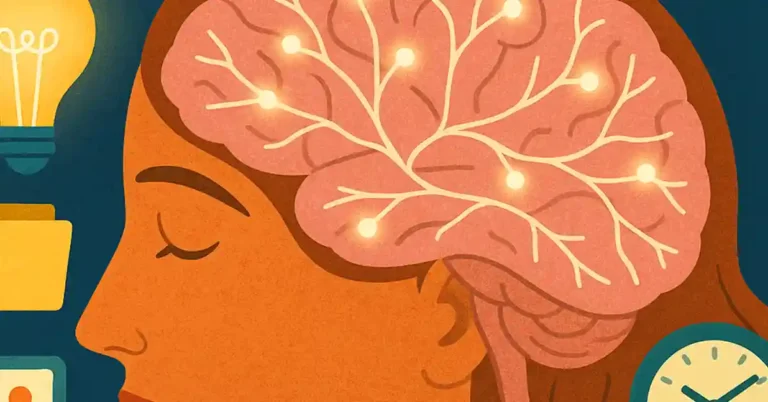
Cognitive Drift vs. Attention Residue: Why Focus Lingers
Cognitive drift vs. attention residue: the first is an informal phrase for thoughts gradually wandering away from a task. The second is a more specific research concept describing how thoughts about a previous task can persist after you have switched to another task. You might experience both in the same afternoon, but they do not mean the same thing.
For example, planning dinner while reading an article is ordinary task-unrelated thought, sometimes described as cognitive drift. Still thinking about an unfinished email while leading your next meeting is closer to attention residue. Explore our cognitive drift guide and attention residue overview for their individual backgrounds.
Comparison Table: Two Different Attention Problems
| Question | Cognitive drift | Attention residue |
|---|---|---|
| Is it a standardized research term? | Not consistently; often informal | Yes, studied in task-switching research |
| Common trigger | Boredom, self-generated thoughts or a gradual loss of focus | Leaving a previous task mentally unfinished |
| Typical experience | “My thoughts wandered away.” | “I’m still thinking about the last project.” |
| Best first step | Notice and reconnect to the current task | Record where the prior task stands and your return point |
| Clinical diagnosis? | No | No |
What Does Cognitive Drift Actually Mean?
The phrase can describe an everyday gradual change in focus. Psychology more often uses mind wandering to study spontaneous task-unrelated thought. Neither is an automatic sign of a disorder. A drift can be brief and harmless, but in tasks that depend on close attention it can cause missed information.
Because the expression also occurs in technical conversations about AI and other systems, context matters. Our cognitive drift versus mind wandering article addresses that terminology in more detail.
What Is Attention Residue?
Organizational researcher Sophie Leroy introduced the attention-residue concept in a 2009 paper on switching between work tasks. The idea is that thoughts related to task A can remain active while you are attempting task B, making full attention to B more difficult.
The experiments showed that switching away from unfinished work could reduce subsequent task performance. Finishing the previous task did not, by itself, guarantee a clean transition in every condition. The findings come from controlled experiments, so they should not be overstated as a universal number of lost productivity hours.
Three Everyday Scenarios
Scenario 1: The Page You Didn’t Really Read
You are reading a chapter but begin imagining your weekend. After five minutes you cannot summarize what happened. This is a straightforward example of drifting attention, not necessarily attention residue.
Scenario 2: The Unfinished Message
You leave a half-written message to join a video call. During the call you keep rehearsing how to finish the message. This is a clear illustration of attention residue after task switching.
Scenario 3: Both at Once
You switch from grading essays to a lesson-planning task. First, thoughts about grading persist. Later, your thoughts drift toward an unrelated memory. The first pattern resembles attention residue; the second is more like mind wandering.
A Three-Minute Task-Switching Routine
- Minute 1—Close or record the old task: finish a small step if reasonable, or write what remains incomplete.
- Minute 2—Write the return cue: “Next: verify the third quotation and revise paragraph four.” This reduces the need to rehearse an unfinished plan.
- Minute 3—Start task B deliberately: identify one concrete outcome for the next block, silence unnecessary alerts and begin.
This routine is a practical organizational strategy, not a treatment proven by Leroy’s study. It can be adapted for homework, research and office work; test whether it actually helps your own comprehension or task completion.
How to Respond When You Notice Drift
Rather than restart your whole day, identify the last sentence or step you understood, then continue from there. If the thought is relevant and important, note it in a trustworthy task list. If a legitimate break is needed, take one. The goal is deliberate reorientation, not eliminating every spontaneous thought.
Why More Multitasking Isn’t the Answer
Switching rapidly between screens may give the impression that everything is advancing, but it can leave more unfinished work competing for attention. Where possible, bundle similar tasks, make the next action explicit, and choose a manageable stopping point before changing activities.
Frequently Asked Questions
Is attention residue just another word for mind wandering?
No. Residue concerns persistence of earlier task-related thoughts after switching; mind wandering can involve thoughts unrelated to any preceding task.
Do unfinished tasks always cause attention residue?
No. Effects vary across situations and individuals. The research describes patterns and conditions, not an inevitable outcome.
Does cognitive drift mean ADHD?
No. The phrase is not a diagnostic criterion. Persistent functional difficulties warrant individualized professional assessment.
Primary research: Sophie Leroy (2009), attention residue and task switching. Related: Cognitive Drift; Attention Residue; Cognitive Drift vs. Mind Wandering.