Ultrablack Wool Dyeing: What 2026 Research Reveals
Ultrablack wool dyeing uses polydopamine—a dark, melanin-like polymer—alongside fabric structure and, for the deepest black, plasma surface treatment to suppress reflected light. A 2026 study shows that both the chemistry inside wool fibres and the way yarns are assembled matter. For textile designers, this is less a new shade of black paint than a new way to engineer how cloth interacts with light.
What did the 2026 ultrablack wool study discover?
In a 2026 research paper on polydopamine dyeing in ultrablack wool textiles, researchers investigated dopamine polymerization, wool fibre chemistry and fabric construction together. Optimized dyeing conditions reduced processing time to roughly 15–30 minutes for the tested merino and other wool fabrics. Importantly, that figure describes a laboratory dyeing step, not the entire production process or a commercial factory cycle.
The team found that fabric architecture strongly affects light absorption and reflection across viewing angles. They also observed that polydopamine-related species penetrate parts of the wool fibre during dyeing, rather than merely sitting as a superficial coating. Subsequent plasma treatment can create additional light-trapping surface texture.
How does polydopamine make wool look so black?
Polydopamine, often abbreviated PDA, forms through chemical reactions involving dopamine. Its broad light absorption resembles some properties of natural melanin. But colour chemistry alone does not explain an ultrablack appearance. Light can still scatter from fibres, gaps, yarn twists and fabric surfaces.
Three levels of design interact:
- Chemistry: PDA absorbs incoming light, with uptake influenced by wool’s keratin and fibre structure.
- Fibre surface: Plasma processing can produce fine structures that help trap light and reduce reflection.
- Fabric construction: Knit or woven geometry, density and napped surfaces alter the path light takes through the cloth.
This is why a dye recipe that performs well on one fabric cannot automatically be assumed to produce identical results on another. The study reports differences associated with fibre fineness and fabric architecture.
Ultrablack wool versus ordinary black wool
| Feature | Conventional black wool | Experimental PDA ultrablack wool |
|---|---|---|
| Colour mechanism | Dark dye absorbs visible light | PDA absorption plus engineered light trapping |
| Appearance | May show highlights, texture and folds | Designed to suppress reflection, including at wider angles |
| Production maturity | Established textile processes | Research-stage processing and optimization |
| Practical unknowns | Properties depend on dye and fabric | Industrial costs, repeatability and lifecycle impacts need assessment |
A 2025 Nature Communications study on ultrablack wool reported average total visible reflectance of 0.13% for its treated samples. That is a measurement for a particular experimental material and method, not a guaranteed performance specification for every PDA-dyed textile. The 2026 work extends understanding of why the process behaves differently across fibres and constructions.
Why does this matter to artists and textile designers?
Depth, silhouette and stage lighting
Black fabric is not visually uniform. Under bright directional lighting, folds and seams can become apparent through highlights. Materials that scatter less light could offer unusual depth effects in costumes, installations and exhibition backdrops. Designers would still need to test drape, stitching, handling, illumination and audience viewing angles before adopting the material.
Functional design beyond fashion
Textiles that absorb light efficiently may also interest researchers developing photothermal systems and flexible optical surfaces. A separate 2026 study of PDA-wool solar vapour generation investigated a laboratory water-evaporation application. That does not mean an ultrablack jacket is a practical desalination device, or that all such fabric will perform similarly.
Cosmic Teapot has also explored radiative cooling fabrics, which pursue a contrasting optical objective: reflecting sunlight while emitting thermal radiation. The comparison is useful because a material that absorbs visible sunlight extremely well is not automatically desirable for staying cool outdoors.
Is ultrablack wool sustainable or ready to buy?
Using wool and a melanin-like polymer may offer material-design advantages, but sustainability cannot be established from ingredient names alone. Researchers and manufacturers would need to evaluate chemical inputs, plasma-processing energy, water use, durability, care requirements, sourcing and end-of-life impacts. Claims of universal environmental superiority would be premature.
Likewise, a faster dyeing stage is promising without proving mass-market readiness. Quality control across different wool batches, large fabric widths, equipment types and repeated washing must be assessed under realistic manufacturing conditions. Designers interested in alternative textile coloration can compare this approach with living bacterial dyeing and fermented pigments, which use quite different mechanisms and face their own scale-up challenges.
FAQ: Ultrablack wool dyeing
Is polydopamine the same as dopamine in the brain?
No. Dopamine is a chemical precursor here; polymerization creates a material with different properties. The study concerns textile chemistry, not neurological effects.
Does polydopamine alone make fabric ultrablack?
Not necessarily. The strongest effects depend on a combination of absorption, fibre structure, fabric geometry and, in the studied process, plasma treatment.
Can I reproduce this at home?
The published method uses controlled chemicals and specialist processing, including plasma treatment. It is not a tested home-dyeing recipe.
Will ultrablack clothing become commonplace?
That remains uncertain. The research provides a stronger technical foundation, but commercial availability depends on manufacturing, durability, cost and demand.
The design takeaway
The central lesson of the 2026 work is that blackness can be engineered across multiple scales. Molecules absorb light, fibre surfaces redirect it, and fabric construction determines how it travels. That combination opens intriguing creative possibilities while leaving practical production questions to be answered.
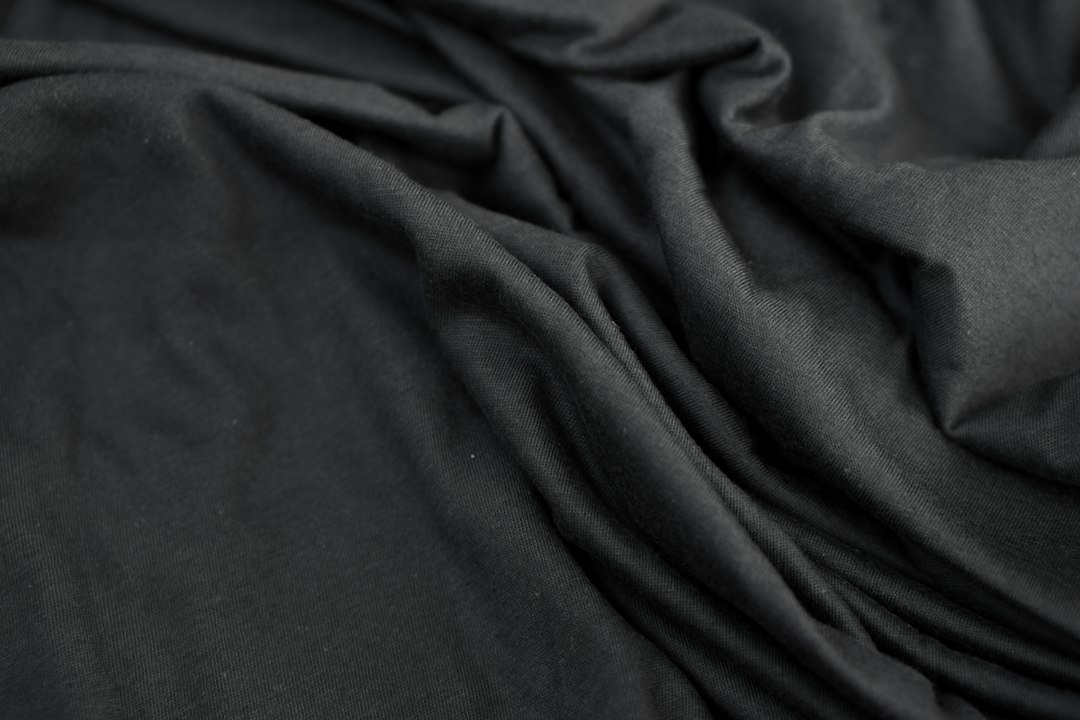
Image: illustrative black fabric photograph, not a sample from the cited experiments.