Can Quantum Sensors Replace GPS? How Atom Interferometers Navigate Without Satellites
GPS feels like part of the natural environment until it disappears. Satellite navigation signals are extraordinarily useful but weak by the time they reach Earth, which makes them vulnerable to obstruction, interference and deliberate jamming. Researchers are therefore developing navigation systems that can keep track of motion without constantly asking satellites where they are.
One of the most ambitious approaches uses quantum sensors, particularly atom interferometers, to measure acceleration and rotation with extreme precision.
How could quantum navigation without GPS work?
Quantum navigation usually refers to using very precise quantum sensors as part of an inertial navigation system. If a vehicle knows its starting position and can continuously measure every acceleration and rotation afterward, it can calculate where it has moved without receiving an external GPS signal.
The problem is drift. Tiny measurement errors accumulate over time. According to a 2026 NIST explainer on atom interferometry, quantum accelerometers and gyroscopes could reduce that drift enough to improve long-duration navigation.
What makes the sensors “quantum”?
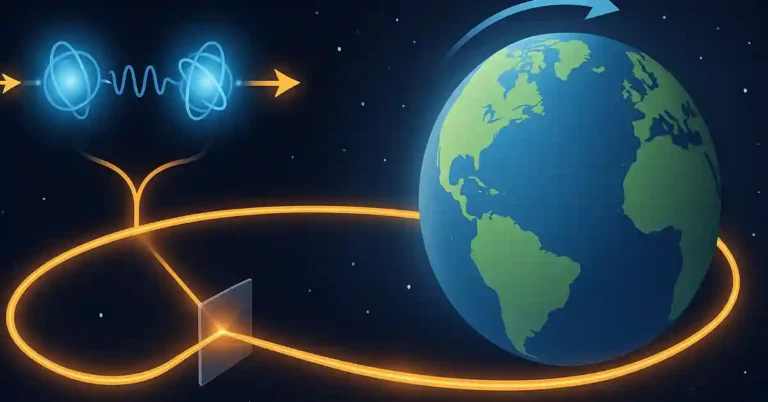
Atom interferometers cool and control atoms so their wave-like quantum behaviour can be used as an exquisitely sensitive measurement tool. Laser pulses split and recombine atomic wave packets. Acceleration, gravity or rotation changes the interference pattern.
The result is not a tiny quantum GPS receiver. The sensor measures motion itself with high precision.
If you want background on the physics, Cosmic Teapot’s guide to quantum physics terms explains several of the concepts involved, while measuring Earth’s rotation with quantum effects shows how sensitive modern quantum experiments have become.
Why not just use ordinary inertial navigation?
Aircraft, submarines and spacecraft already use accelerometers and gyroscopes. Classical inertial navigation can be excellent over limited periods, but small biases in the sensors eventually accumulate into large position errors.
Quantum sensors are attractive because atoms provide stable physical references. A 2026 review in GPS Solutions surveyed quantum sensing approaches for positioning and navigation, including atom interferometry, quantum magnetometers and quantum clocks.
Could quantum sensors completely replace GPS?
Probably not in the near term, and replacement may not be the best goal. GPS provides a direct external position reference across enormous areas. Quantum inertial systems estimate position by integrating motion, which means even excellent systems can still drift.
A more realistic future is hybrid navigation. Vehicles could combine satellite signals, classical sensors, quantum sensors, terrain or gravity maps and other references. When one source becomes unavailable, the others can keep the navigation solution stable.
Where would GPS-free navigation matter most?
Submarines are an obvious example because water blocks satellite signals. Aircraft and ships operating in regions with heavy GPS jamming are another. Underground vehicles, spacecraft and autonomous systems could also benefit from navigation that does not depend on constant radio contact.
There are civilian uses too. Better inertial sensors could help mapping, geology and infrastructure monitoring, especially where satellite reception is unreliable.
What is holding quantum navigation back?
Laboratory atom interferometers can be large, delicate and complex. Cooling atoms, stabilizing lasers and isolating the system from vibration are difficult engineering problems. The challenge is shrinking research-grade precision into rugged hardware that can survive on a moving vehicle.
That is why quantum navigation is best viewed as a developing technology rather than a GPS replacement you should expect in a phone next year. The physics is real; the engineering race is about making it practical.