Medieval Marginalia Explained: Why Old Manuscripts Have Such Weird Drawings
Medieval marginalia can make an old manuscript look unexpectedly modern. Around serious religious texts, legal writing and scholarly pages, you may find tiny animals, odd creatures, comic scenes, decorative vines and strange little visual jokes.
To a modern viewer, these images can look like random doodles. Sometimes they really were informal additions. But many were planned illustrations created as part of the manuscript itself, and they can tell us a great deal about medieval humor, symbolism and bookmaking.
What is medieval marginalia?
Marginalia simply means material placed in the margins of a text. In medieval manuscripts, that can include written notes, corrections, symbols, decorations and illustrations.
The images are sometimes called marginal illustrations or drolleries. They can appear beside religious writing, poetry, legal texts and other handwritten books.
The important point is that not all marginalia came from the same person or served the same purpose. Some decoration was created when the book was made. Other notes and sketches were added later by readers or owners.
Why are medieval manuscript margins so strange?
Part of the answer is that the margin offered a different kind of visual space.
The main illustration in a manuscript often had a clear relationship to the text. The margins could be more playful. Artists might echo the subject of the page, twist it, joke about it or introduce imagery that seems almost unrelated.
A 2026 guide to interpreting medieval marginalia from Weird Medieval Guys makes an important point: these pictures were usually not random products of boredom. They belonged to a rich visual world shaped by religion, folklore, humor and popular culture.
The British Library has also highlighted the lively marginal imagery found in books of hours and other manuscripts, showing how the edges of a page could become a place for imaginative visual play.
Were medieval marginalia just doodles?
Sometimes, but not always.
A later reader might add a quick sketch, pen test or note in empty space. Those additions can be valuable because they show how real people interacted with a book after it was made.
But many elaborate marginal scenes were created by professional artists as part of the original decoration. They may have been carefully planned after scribes finished writing the text.
Calling all marginalia doodles can therefore hide an important distinction between intentional illumination and later reader marks.
What kinds of images appear in medieval margins?
The range is enormous. Common examples include:
- animals behaving like people;
- hybrid creatures made from several familiar forms;
- knights, musicians and workers;
- decorative plants and vines;
- comic reversals where ordinary roles are flipped;
- small scenes that echo or parody ideas from the main text;
- notes and symbols added by later readers.
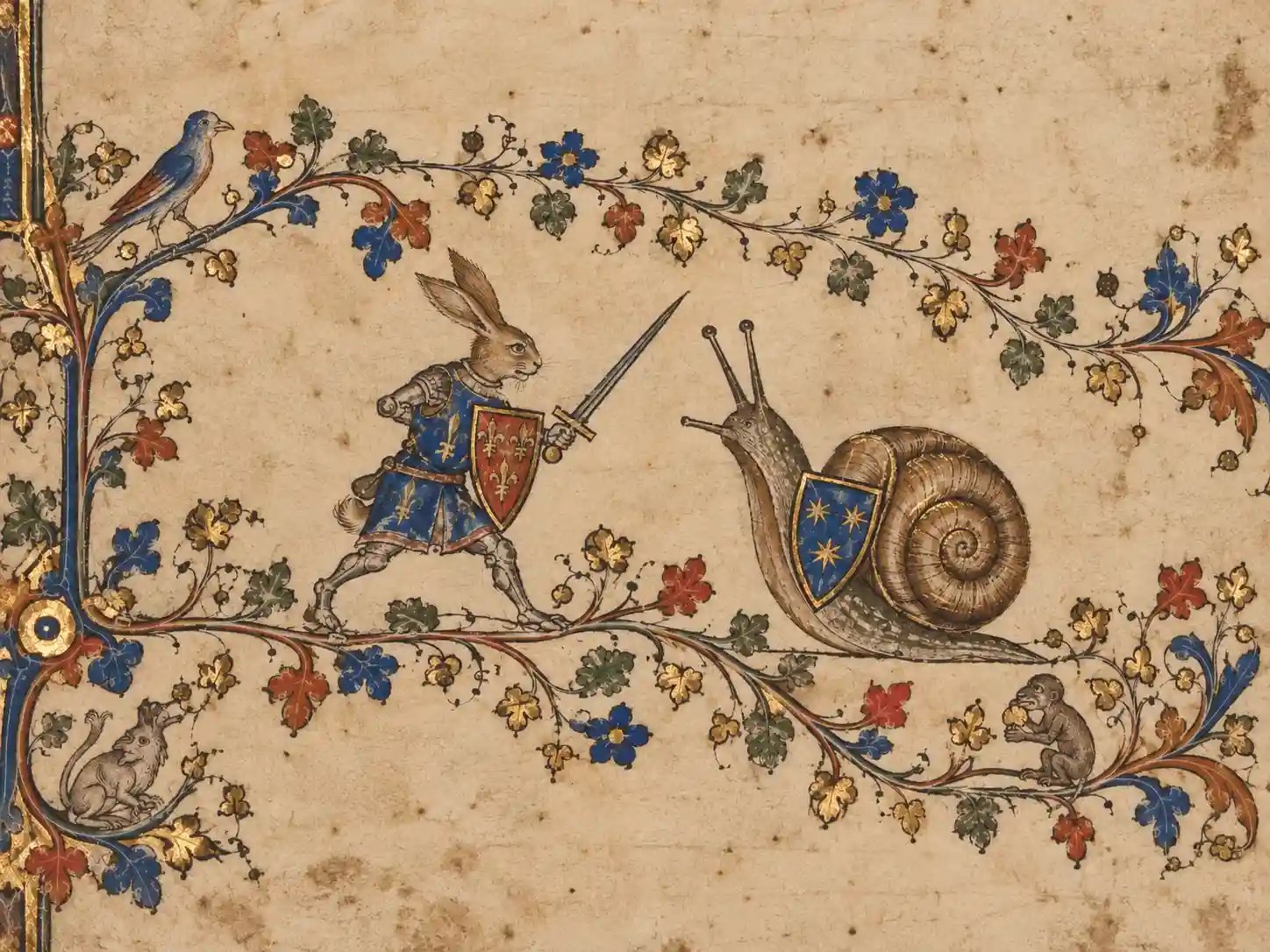
One of the most famous recurring images is the knight facing a snail. Scholars have offered several possible interpretations, but no single explanation accounts for every example. That uncertainty is part of what makes marginalia so fascinating.
Why did artists put jokes in serious books?
Modern readers often imagine medieval books as uniformly solemn objects, especially because so many surviving manuscripts are religious. The margins remind us that medieval culture also had humor, parody and visual play.
A serious text and a comic border were not necessarily seen as incompatible. The contrast itself could be meaningful.
Some images reinforced a lesson. Others may have invited reflection by turning normal expectations upside down. Still others may simply have been entertaining.
Marginalia can reveal how books were used
Later additions are especially valuable to historians because they show that books had lives after they left the workshop.
Atlas Obscura has discussed how marginal notes, pen tests and later drawings can help researchers reconstruct the history of a manuscript and the people who handled it.
A correction may show close reading. A practice letter can show someone testing a pen. A later drawing can reveal that a book continued to be used long after its original owner was gone.
In that sense, a manuscript margin can function almost like an archaeological layer.
Why medieval marginalia keeps going viral
The images translate surprisingly well to modern internet culture. A tiny animal doing something unexpected can be funny even when we do not understand the original context.
That visual immediacy makes medieval marginalia easy to share, but it also creates a risk: once an image is removed from its page, people may assume it was random when it had a specific relationship to the surrounding text.
The best way to enjoy these images is to keep both ideas in mind. They can be genuinely funny to us today and still have had meanings that were obvious to medieval viewers.
What marginalia tells us about the Middle Ages
The margins make medieval books feel less distant. They show people experimenting, joking, correcting mistakes, decorating pages and interacting with texts as physical objects.
They also challenge the stereotype of the Middle Ages as a culture without humor or visual play.
A manuscript was not just a container for words. It was an object made by many hands, used by many readers and sometimes changed over centuries.
FAQ
What does marginalia mean?
Marginalia refers to notes, marks or images placed in the margins of a text.
Who drew medieval marginalia?
Some images were created by professional illuminators during production, while other marks and drawings were added later by readers or owners.
Were medieval marginal drawings random?
Some informal additions may have been spontaneous, but many marginal illustrations were carefully planned and connected to broader visual traditions.
Why are there so many strange animals in medieval manuscripts?
Animals and hybrid creatures gave artists flexible ways to create humor, symbolism, inversion and imaginative decoration around the text.
More on medieval marginalia and everyday history
For related historical evidence, read what Pompeii graffiti reveals about daily life and how ancient DNA reconstructs family trees and migration.
Explore more stories about books and the past in our Books and History sections.